Director Interview

Hori Smoku Sailor Jerry is an award-winning documentary exploring the roots of American tattooing through the life of its most iconoclastic figure Norman "Sailor Jerry" Collins. It features rare archival footage, photos, and interviews with legendary tattoo artists like Mike Malone, Don Ed Hardy, Zeke Owen, Bob Roberts, Lyle Tuttle and ‘Philadelphia' Eddie Funk. Here, Erich Weiss, the director of the film, answers some questions.
Who exactly was Norman "Sailor Jerry" Collins and how did you first come to recognize his work?
Sailor Jerry is considered one of the more prolific tattoo artists of the 20th century. He tattooed in the vice district of Honolulu's Chinatown (known as Hotel Street) for roughly 40 years. When you think of the "rough and tumble" sailor tattoo…well, he pretty much symbolizes that.
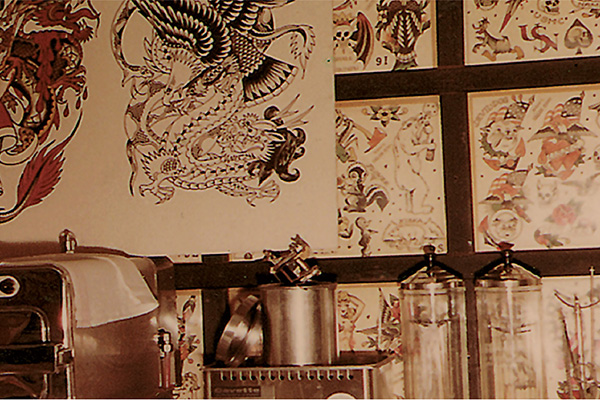
When I first got tattooed, I remember how plain scary walking into a tattoo shop was. There were usually bikers and other rough people hanging out in those spots. No one was friendly, or welcoming or any of that garbage - it was an intimidating experience. And it was awesome. I remember first seeing Jerry's flash up on the walls of shops like that, and thinking, "Man, this stuff is great"…and not to get all chin-scratchy but it was intriguing to see what was really an American folk art on the walls of a place that was the farthest thing from a traditional art gallery.
Norman Collins was a man of many interests – what were some of the other topics that interested him?
He was a jack-of-all-trades. Obviously he was sailor and a tattoo artist. But he really was a social chameleon. He was interested in electronics, "the dawning of computers," that kind of thing…he was an ace mechanic. He studied Asian philosophy and could speak Chinese. He played the saxophone as well. He had his own radio program, "Old Ironsides", which would broadcast late at night on KTRG Honolulu. He was a social libertarian in the strongest sense of the word, and his show consisted of his political rants interspersed with poetry. Not something you'd really expect from a guy who spent his days tattooing sailors in the vice district of Hotel Street, Chinatown.
What is it about his designs that have made them so timeless?
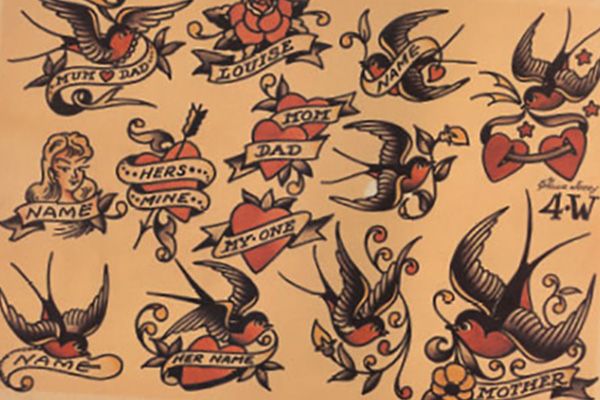
Most of the basic, traditional "sailor" tattoo designs have been around since the early 1800's. "Rose of No Man's Land", Eagles, flags, all those patriotic and nautical designs…old school artists like Owen Jensen, Cap Coleman, Joe Lieber, all worked off those old motifs…and so did Jerry, modifying them to fit the times. What was so unique about Jerry was that he took it to the next level- he was one of the few tattoo artists of his time that took those traditional, Americana, bold looks and incorporated the styles and techniques that were being used across the Pacific in Japan.
Where did the Hori Smoku title come from?
Hori Smoku was the self-imposed moniker of Sailor Jerry. The Japanese tattoo masters go by the surname "Hori" which when loosely translated means "to carve". Jerry called himself "Hori Smoku" as a kind of dig to the Japanese tattoo masters- so that if the nickname were said in a thick Japanese accent it would sound more like "Holy Smoke". He was a bit of a ball -buster, and I think this nickname was really indicative of his personality in total…so that's why I chose it for the title.
How did Asian culture and tattoo styles influence Collins own work?
He was one of the few American tattoo artists that corresponded directly with the Japanese tattoo masters (Horis), exchanging design styles, shading techniques, ink, color information, etc. You have to remember that this was right after WW2, and Jerry being a military man, had a lot of "pre-conceived" notions in regards to the Japanese- the memory of Pearl Harbor was still fresh in the American mindset. So for him to make the effort to correspond and dialogue with these secretive Japanese masters – well, it really showed a love of the art and a desire to bring it to the next level.
What do you consider Collin's greatest impact on the art of tattooing?
Like I said, he really helped bring tattooing into the 21 century. Not just stylistically, but also in his advancement on the technical side of things. He was a huge proponent of sterilization and really advanced the design of the tattoo machine. He created purple ink- which expanded the color palette of tattoos. I think his overall designs are timeless…hell, just go to your local bar and check out some of the patrons. Unless you're right next to the navy yard, I'm pretty sure many of those people have never been on a proper shore leave…yet you'll see sparrows, stars, and ships all up and down their arms.
So hey, there you go…